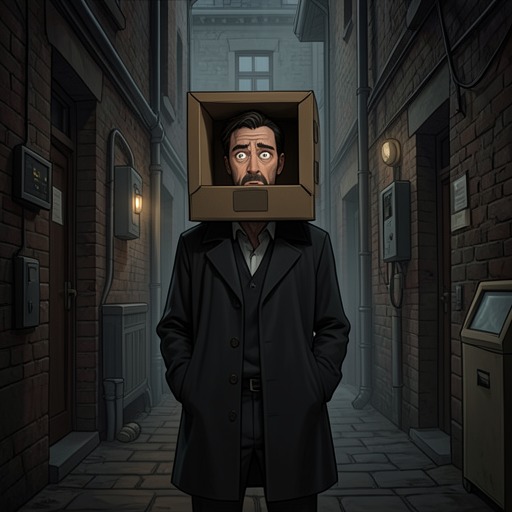
A Shoots the Box Man and Becomes One
The Box ManA Shoots the Box Man and Becomes One marks a reversal: A first treats a box man as an intolerable intrusion, then gradually makes the box a place of refuge and leaves home wearing one. The episode traces that change from a confrontation at A’s apartment window to a new way of living that he does not immediately understand.
The Encounter and Its Escalation
A box man settles directly below A’s apartment window. A tries not to look, but the stranger’s presence occupies his attention. He resents what he sees as an illegal encroachment on his territory, yet initially waits for someone else to act. The building’s janitor does not resolve the matter, and the box man is visible only from A’s window; other residents can simply avoid acknowledging him. When A complains at a police box, the officer tells him to file a damage report and asks whether he has clearly ordered the man to leave. A experiences this exchange as a first brush with fear, and returns home with the problem still his to handle.
On the way back, A borrows an air rifle from a friend. He pauses at home to smoke and calm himself, but when he looks out again, the box man has turned the observation slit toward him. Only a few yards separate them. The box tilts, its translucent vinyl curtain parts, and an indistinct eye is fixed on A. The exchange is wordless, but its directness sharpens A’s agitation: he opens the window, loads the rifle, and takes aim.
A hesitates over where to shoot. He considers the risk of hitting the box man in the eye and the trouble that might follow, and hopes a threat will be enough to make the stranger leave. He does not want bloodshed, but his anger returns as he imagines where the man is positioned behind the cardboard and canvas. He finally fires. The box jumps at the impact; A sees no immediate dramatic response and cannot tell precisely where the shot has landed. The box man remains still for a time, then begins to move, leaving A to watch and wait for what will happen next.
The box man eventually rises, turns, stretches, and walks away with the box swaying slightly. A cannot make out what he says, and the man disappears around the corner without revealing his face. A is disappointed that he has not seen the expression behind the box. The departure resolves the immediate face-to-face encounter, but not A’s involvement in it: the silence and uncertainty leave him with no clear account of what the shot has done or what the box man’s departure means.
The Box Becomes a Refuge
For about half a month, A nearly forgot the encounter, though he avoided the narrow lane on his way to the station and continued looking from his window when he woke and when he returned home. The effort to put distance between himself and the Box Man did not end his attention to the place where the stranger had been. That unresolved vigilance returned when a new refrigerator arrived in a corrugated cardboard box of just the right size. The empty container brought back the sound of the shot and the thought that its bullet was still ricocheting in his mind. Instead of throwing the box away, A closed the curtains and cautiously crawled inside.
The dark interior, with its smell of waterproof paint, felt unexpectedly homelike. A wanted to stay there, but came to his senses in less than a minute and climbed out, unsettled enough to keep the box. The following day he cut an observation window in it and tried wearing it over his head, then immediately took it off and kicked it into a corner. His rejection was not complete: he left the box intact, and on the third day looked through its opening again. The familiar room appeared newly sharp and uncomfortable, while the view from behind the aperture seemed smoother. A began to reconsider his prejudice against boxes, although he could not explain the change that had already begun.
The shift became a routine. The next day A watched television with the box over his head; from the fifth day onward, he spent nearly all his time at home inside it, apart from sleeping, eating, and other daily bodily needs. He found the arrangement more natural and more comfortable than the bachelor life he had previously accepted. On the first Sunday, when he had no visitors or plans, he stayed in the box from morning and recognized by midday that something was missing. He went into town for supplies, including a chamber pot, flashlight, thermos, picnic set, tape, wire, hand mirror, poster colors, and food that required no preparation. Back home, he reinforced the cardboard with tape and wire and arranged the objects within it.
The mirror made the small enclosure a place where A could alter how he appeared to himself. By flashlight, he colored his lips green and traced the seven colors of the rainbow around his eyes, seeing his face as more like a bird or fish than a human one. He imagined becoming the contents suited to the container. The box had begun as the sign of an unwelcome stranger; now it offered A a private interior and a way to inhabit a changed relation to the room around him. A week after first entering the refrigerator carton, he went stealthily out into the streets wearing it and did not return.
Making a Life Inside the Box
The box’s interior is not simply a hiding place; it can be fitted out as a small working environment. The narrator’s practical instructions emphasize limiting possessions to what can be arranged and used: a radio, mug, thermos, flashlight, towel, and small bag can be hung from wire hooks bent for the purpose. Rubber boots need only be sound, while canvas wrapped around the waist can steady the box against the body and leave room for movement. Such details give the cardboard enclosure a double character. It obscures its occupant, but it also becomes a shelter that must be adjusted around the ordinary demands of daily life.
Its openings likewise serve more than one function. Tilting the box changes the breadth of the view through its slit, which the narrator treats as an expressive feature as well as a means of looking out. Additional small openings in the side walls can help distinguish the direction of sounds. These modifications turn a seemingly crude covering into a selective interface with the street: the person inside controls what can be seen and how much of the outside world enters, while remaining difficult for passersby to read.
Once outside, the box man’s routine is shaped less by dramatic encounters than by practical necessity. The narrator describes the initial self-consciousness and reserve toward other people as temporary; eating, sleeping, and other daily functions cannot be suspended simply because someone lives under a box. Food, in particular, draws the box man toward busier parts of town. Leftovers can be difficult to use, and the narrator describes the search for food as requiring attention to both hygiene and the mixed odors of discarded meals. Yet he says that food can also be obtained from store counters, making the city itself a place to learn through repeated movement rather than merely a source of supplies.
That gradual familiarity changes the experience of time. As the box man becomes accustomed to town, the surrounding world seems to move quickly, while what lies immediately before him passes slowly and the center remains still. The account therefore gives A’s departure a practical horizon beyond the apartment: wearing the box means entering a mode of urban life organized around adaptation, concealment, and attention to small necessities. The episode ends at the threshold of that life, while the narrator’s later description shows how its constraints can become a distinctive way of inhabiting the city.
The Anonymous City and the Reversal of the Encounter
A’s departure turns the episode’s opening confrontation inside out. At first, he treats the box man as an illegal intrusion and believes a gun may restore the boundary of his home; a week later, he leaves wearing the same kind of enclosure. The narration widens this personal reversal into a challenge to the reader’s assumed distance from box men: the anonymous city imagined for people without names is a place where strangers need not remain on guard and where unconventional ways of moving or resting need not invite blame. A’s transformation does not prove that he has reached such freedom, but it makes the possibility difficult to dismiss as someone else’s condition. The account closes by recasting the shot not as a solution to the encounter but as a warning: the person enclosed in the box may be closer to the observer than the observer wishes to admit.